
Table of Contents
TogglePlanning a home theater installation means balancing dreams of cinematic sound and picture quality with real-world budgets. The total cost swings wildly depending on room size, equipment quality, and whether someone’s doing the work themselves or hiring professionals. For a basic setup, homeowners might spend $2,000 to $5,000, while mid-range systems typically run $8,000 to $15,000. High-end installations can climb past $50,000 or more when factoring in dedicated screening rooms, architectural treatments, and premium components. Understanding where money goes, and where it can be saved, helps turn theater dreams into reality without financial regrets.
Key Takeaways
- Home theater installation cost typically ranges from $4,500 to $13,500, with most homeowners spending around $8,000 to $9,000 for a complete system including equipment, labor, and professional installation.
- Audio systems matter more than video displays for creating immersion—prioritizing a $2,500 audio system over a higher-priced TV delivers better overall value and home theater experience.
- Professional installation labor accounts for 20-35% of total home theater installation cost, making hybrid DIY approaches (handling wiring yourself while hiring professionals for calibration) a smart way to save 40-60% on labor.
- Hidden costs including acoustic treatment ($800-$2,500), electrical upgrades ($250-$600 per circuit), seating ($400-$3,500 per seat), and lighting control ($200-$2,500) significantly impact final budgets and should be planned for upfront.
- Phasing your project by starting with display and basic 3.1 audio, then adding surrounds later, allows you to benefit from technology improvements and price reductions while spreading costs over time.
Average Home Theater Installation Costs
According to current home theater installation pricing data, most homeowners spend between $4,500 and $13,500 for a complete home theater system, with the national average landing around $8,000 to $9,000. These figures include equipment, labor, and basic installation but assume an existing room without major structural modifications.
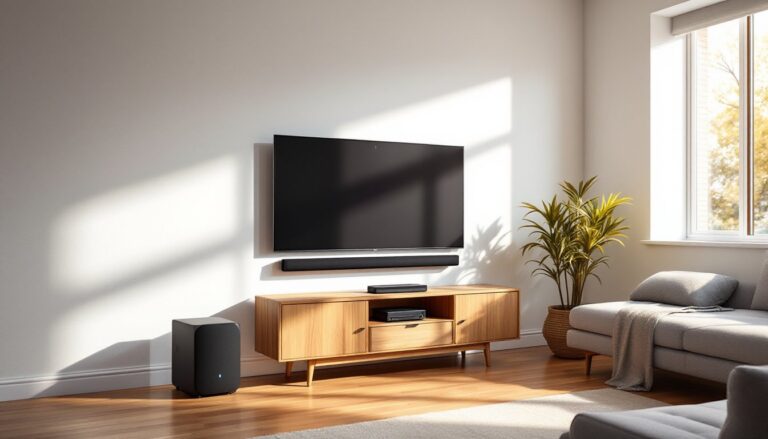
Entry-level systems start around $2,000 to $3,500 and typically include a budget 4K TV or projector screen, a soundbar or basic 5.1 surround system, and minimal professional installation. These setups work fine for casual viewing in multi-purpose spaces like family rooms.
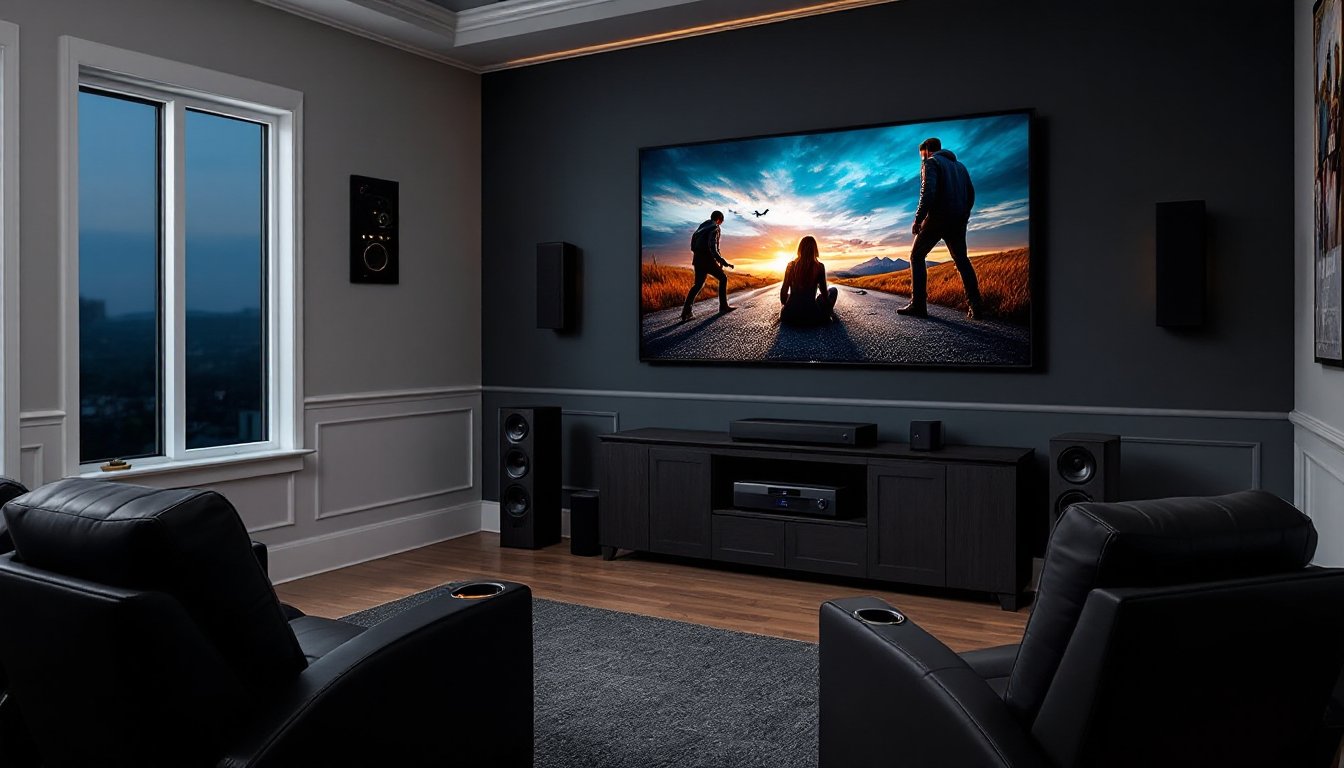
Mid-range installations, where most homeowners land, run $8,000 to $15,000. This budget covers a quality 75-85 inch 4K TV or a 1080p/4K projector with a 100-120 inch screen, a proper 5.1 or 7.1 surround sound system with in-wall or in-ceiling speakers, an AV receiver, and professional calibration. Add another $1,500 to $3,000 for basic acoustic treatments like panels or bass traps.
High-end dedicated theaters start at $25,000 and easily exceed $75,000 to $100,000 for luxury builds. These include premium projectors with true 4K resolution and HDR, custom motorized screens, Dolby Atmos or DTS:X systems with 9+ channels, acoustic engineering, custom seating, lighting control, and sometimes structural work like soundproofing or room-within-a-room construction.
Labor typically accounts for 20-35% of total project costs. Professional installers charge $75 to $150 per hour depending on region and complexity. A basic install might take 8-12 hours: complex systems with custom wiring, in-wall speakers, and rack equipment can require 30-50+ hours.
Breaking Down Equipment and Component Costs
Display and Screen Options
Flat-panel TVs remain the most popular display choice for home theaters. A quality 65-inch 4K TV costs $600 to $1,200: 75-inch models run $1,000 to $2,500: and 85-inch premium displays reach $2,500 to $5,000 or more. OLED panels offer superior contrast and black levels but cost 30-50% more than comparable LED models. For true theater feel, though, many choose projectors.
Projector systems start around $700 for basic 1080p models suitable for casual use. Quality 4K home theater projectors begin at $1,500 to $2,500, while enthusiast-grade models with HDR, high brightness (2,500+ lumens), and accurate color run $3,500 to $8,000. High-end laser projectors start around $5,000 and can exceed $15,000.
Projection screens add another layer of cost. Manual pull-down screens start at $200 to $400 for a 100-120 inch diagonal. Fixed-frame screens with better optical properties run $500 to $1,500. Motorized screens with masking or ambient light rejection materials cost $1,200 to $4,000. Screen gain, material type (matte white, grey, or ALR), and aspect ratio all affect pricing.
Audio System Expenses
Sound typically matters more than picture for immersive experience, yet it’s where many cut corners. A basic 5.1 surround system (five speakers plus subwoofer) starts at $500 to $800 for entry-level packaged systems. Better speaker packages run $1,500 to $3,500, while high-performance tower speakers and matched center channels can cost $3,000 to $10,000+ for the front three speakers alone.
AV receivers range from $300 for basic 5.1 models to $1,500 for mid-grade 7.1/9.1 units with Dolby Atmos, DTS:X, 4K/8K passthrough, and room correction. Premium receivers and separates (pre-amp/processor plus power amplifier) cost $2,500 to $10,000 or more.
In-wall and in-ceiling speakers offer cleaner aesthetics. Decent models cost $150 to $400 per speaker: premium architectural speakers run $500 to $1,200 each. Budget $100 to $250 per speaker for professional installation including wire runs, cutting drywall, and finishing.
Subwoofers handle low-frequency effects. Entry models start at $200 to $400: quality subs that deliver clean, powerful bass cost $600 to $1,500. Serious home theater builders often use dual subwoofers ($1,200 to $3,000 total) for even bass response.
Speaker wire and cables add up quickly. Budget $200 to $500 for quality 12- or 14-gauge speaker wire for a typical room, plus HDMI cables ($50 to $200 for certified high-speed or fiber optic runs), subwoofer cables, and any other interconnects. While exotic cables rarely justify their cost, proper gauge wire for long runs matters.
Professional Installation vs. DIY: What to Expect
DIY installation saves the most money but demands time, tools, and comfort with technology. Setting up a TV-based system with a soundbar or simple surround package is straightforward, most homeowners can handle this in an afternoon with basic tools. Running speaker wire through walls, mounting in-ceiling speakers, or installing a projector and screen requires more skill but remains achievable for experienced DIYers.
Professional installation makes sense when projects involve in-wall wiring, equipment racks, complex AV routing, or acoustic treatment. Installers know local electrical codes, understand proper wire management, and carry insurance. They’ll calibrate audio using measurement equipment like REW (Room EQ Wizard) with calibrated microphones, something difficult to replicate without experience.
Typical labor costs from platforms like HomeAdvisor break down as follows: basic TV mounting and soundbar setup runs $150 to $400: full surround sound installation with in-wall speakers costs $800 to $2,000: projector mounting, screen installation, and calibration adds $500 to $1,200: complete home theater integration with rack equipment, control systems, and acoustic treatment runs $2,500 to $8,000 or more.
Hiring a certified custom integrator (CEDIA member) costs more, often 15-25% above general handyman rates, but delivers expertise in system design, future-proofing, and warranty support. They’ll coordinate electrical work if new circuits are needed (home theaters often benefit from dedicated 20-amp circuits to avoid ground loop hum or voltage sag).
One hybrid approach: DIYers can install screens, mount projectors or TVs, and run speaker wire themselves, then hire a professional for final connections, calibration, and troubleshooting. This saves 40-60% of labor costs while ensuring the system performs correctly.
Safety note: Any work involving cutting into walls near electrical, plumbing, or HVAC requires care. Use a stud finder with wire detection, shut off power at the breaker when drilling, and consider hiring an electrician for new outlets or dedicated circuits. Always wear safety glasses when cutting, drilling overhead, or working with tools.
Hidden Costs and Budget Considerations
The sticker price on equipment tells only part of the story. Acoustic treatment significantly improves sound but rarely appears in initial budgets. Basic foam panels cost $100 to $300 for a small room: proper broadband absorbers, bass traps, and diffusers run $800 to $2,500. Professional acoustic design adds $500 to $2,000 but prevents wasted money on ineffective treatments.
Electrical upgrades often surprise homeowners. Older homes may need new circuits to handle power draws from amplifiers, projectors, and other gear. Expect $250 to $600 per new circuit from a licensed electrician. Surge protection and power conditioning add $150 to $800 depending on equipment value.
Furniture and seating matter more than many realize. Basic theater seating starts at $400 to $800 per seat for recliners: dedicated theater seats with cup holders and motorized recline run $1,200 to $3,500 each. Risers for second-row seating cost $300 to $1,200 depending on size and finish.
Lighting control enhances the experience. Simple dimmer switches cost $30 to $80: smart lighting systems like Lutron Caseta run $200 to $600 for a room: full control integration with automated scenes adds $800 to $2,500.
Streaming devices and sources often get overlooked. Budget $100 to $300 for quality streaming boxes or players. Serious enthusiasts add Blu-ray players ($200 to $500) or media servers ($500 to $2,000+).
Long-term costs include electricity (a typical system draws 300-800 watts during use, adding $5 to $15 monthly), lamp replacements for projectors ($200 to $500 every 3,000 to 5,000 hours for bulb-based models: laser projectors avoid this), and equipment upgrades as formats evolve.
Permits may be required for structural work, new electrical circuits, or changes affecting load-bearing walls. Check local building departments. Finishing a basement for a dedicated theater often requires permits covering electrical, framing, and egress. Budget $500 to $2,000 for permit fees and inspections depending on scope.
Cost-Saving Tips for Your Home Theater Project
Prioritize audio over video. A $1,500 TV with a $2,500 audio system beats a $3,000 TV with a $1,000 soundbar. Sound drives immersion: picture quality has diminishing returns past mid-range displays.
Buy refurbished or last-year’s models. AV receivers and projectors see frequent updates, but year-old models often perform nearly identically to current versions at 30-40% discounts. Manufacturer refurbs include warranties and cost 20-30% less than new.
Phase the project. Start with display and basic 3.1 audio (left, center, right, sub), then add surrounds and height channels later. Electronics evolve quickly: waiting allows better equipment at lower prices.
Do your own wire runs. Running speaker wire and HDMI through walls isn’t difficult, it’s time-consuming. Invest $50 to $100 in a fish tape, stud finder, and drywall saw, then tackle this yourself. Just map the path carefully and use proper wire rated for in-wall use (CL2 or CL3 rated for speaker wire: certified HDMI for video runs).
Use DIY acoustic treatment. Rigid fiberglass panels (Owens Corning 703 or Roxul Safe’n’Sound) wrapped in fabric cost $30 to $50 each to build versus $100 to $200 to buy finished. Tutorials abound: construction requires only basic tools and an afternoon.
Shop sales cycles. Black Friday through January sees major discounts on TVs and projectors. Spring often brings deals on last year’s AV receivers as new models launch. For planning resources and project cost estimates, sites like ImproveNet offer helpful comparison tools.
Skip unnecessary features. Do you really need 8K upscaling, wireless rear speakers at 3x the price of wired, or a $2,000 universal remote? Focus budget on elements that affect performance: speakers, subwoofer, screen quality, and acoustic treatment.
Negotiate installation. Get three quotes from different installers. Many will price-match or offer package discounts when buying equipment through them. Cash payment sometimes nets 5-10% discounts from smaller integrators.
A well-planned home theater delivers years of enjoyment. By understanding where costs lie and which elements matter most, homeowners build systems that fit budgets without sacrificing the experience that makes dedicated home theaters worthwhile.