
Table of Contents
TogglePlanning a home theater means more than mounting a screen and arranging chairs. Poor clearance around seating creates awkward sightlines, restricts movement, and makes recliners useless if they can’t fully extend. Homeowners often cram too many seats into a small room or leave too much wasted space, turning what should be a comfortable viewing experience into a logistical headache. Getting the spacing right upfront prevents expensive do-overs and ensures every seat in the house is actually usable, whether someone’s heading to the bathroom mid-movie or kicking back in full recline.
Key Takeaways
- Proper home theater seating clearance requires 24–36 inches of rear clearance for recliners to extend fully, with 36–40 inches between rows, ensuring functionality and comfort.
- Front wall clearance should maintain at least 3 feet between the first-row seatbacks and the screen wall, combined with a 10-foot minimum viewing distance for a 120-inch screen to eliminate eye strain.
- Side wall clearance of 6–12 inches (or 18 inches for footrest extension) prevents scuffing and allows comfortable passage, while aisle widths should be at least 24 inches.
- Always mock up seating with painter’s tape or cardboard before purchasing furniture, as measuring chairs in upright position only is the most common mistake that leads to costly do-overs.
- Account for door swings, HVAC vents, equipment racks, and future flexibility when planning your layout, as poor placement in these areas creates safety hazards and operational frustrations.
- Wall-hugger recliners need only 4–6 inches of rear clearance for tight spaces, while standard recliners and sectionals demand 18–24 inches beyond their static footprint when fully reclined.
Why Proper Seating Clearance Matters for Your Home Theater
Clearance determines whether a home theater functions or frustrates. Insufficient space around seats creates bottlenecks when someone needs to pass, forces uncomfortable postures, and prevents reclining mechanisms from operating fully. In rooms with motorized recliners, inadequate rear clearance means chairs that can’t extend, a waste of money and functionality.
Sightlines suffer when seats are too close to side walls or stacked too tightly row-to-row. Viewers in cramped positions experience neck strain and compromised audio, especially in rooms with surround sound systems where speaker placement depends on listener position. Building codes don’t typically govern home theater seating (unlike commercial venues), but accessibility and fire egress principles still apply if the space doubles as a gathering area.
Proper spacing also protects the room itself. Recliners slammed against drywall leave scuff marks and dents. Cupholders and armrests need clearance to avoid damaging baseboards or adjacent furniture. And if the theater includes tiered platforms or risers, common in dedicated spaces, clearances must account for safe step access and headroom under the ceiling or soffits.
A well-planned layout accommodates real-world use: kids squeezing past adults, trays of snacks, storage ottomans, and the occasional need to reach wall-mounted controls or outlets. Ignoring these factors upfront leads to a space that looks good in renderings but fails in daily operation.
Standard Clearance Measurements for Home Theater Seating
Industry guidelines provide baseline measurements, though personal preference and furniture type introduce variables. These numbers apply to fixed or manual recliners unless noted otherwise.
Front and Side Wall Clearances
Front wall clearance (between the screen wall and the first row) depends on screen size and viewing distance. For a 120-inch diagonal screen, the Society of Motion Picture and Television Engineers (SMPTE) recommends a minimum viewing distance of 10 feet for immersive experiences without eye strain. Add at least 3 feet between the front-row seatbacks and the wall to allow passage and avoid a claustrophobic feel.
Side wall clearance should be 6 to 12 inches minimum from the outer edge of armrests to the wall. This prevents scuffing and provides enough room to slide past seats. If recliners are positioned against side walls, increase clearance to 18 inches to accommodate footrest extension without hitting baseboards. In narrow rooms, consider placing non-reclining seats on the ends or using wall-hugger recliners that need less rear space.
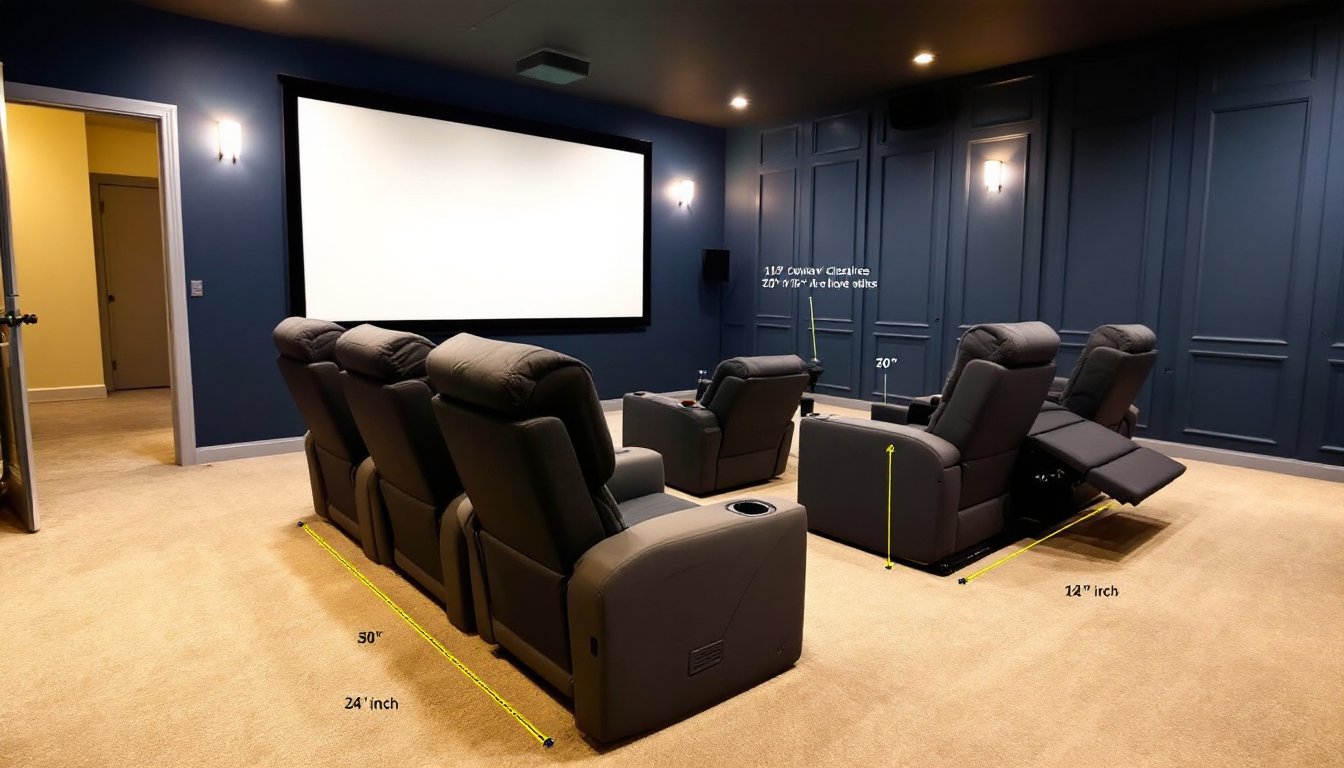
Rear wall clearance for fixed seats can be as little as 3 inches, but recliners require significantly more. Standard recliners need 24 to 36 inches from the seatback to the wall when upright, allowing the chair to tilt and extend fully. Measure from the furthest point of recline, not just the upright position, most failures happen when homeowners assume the advertised seat depth is all they need.
Row-to-Row Spacing Guidelines
For single-row theaters, the main concern is rear clearance for recliners. For multi-row setups, row-to-row spacing becomes critical. The standard measurement is 36 to 40 inches from the back of one row’s seats to the front of the next row’s seats when all chairs are upright. This provides enough legroom and passage space without requiring others to stand.
If the theater uses risers or tiered platforms, increase row spacing to 42 to 48 inches to accommodate the height change and ensure safe footing. Many home renovation ideas featured on sites like HGTV showcase tiered theater designs, but they gloss over the structural planning, risers typically need 8 to 12 inches of height per row and must be anchored to floor joists, which may require a permit depending on jurisdiction.
Aisle width, if the layout includes a center or side aisle, should be at least 24 inches to allow comfortable passage. Wider is better for households with mobility aids or young children. Remember that row spacing compounds: a four-row theater with 40-inch spacing needs 160 inches (13.3 feet) front-to-back, plus clearances at both ends.
Planning Your Layout: Room Size and Seating Configuration
Room dimensions dictate how many seats fit and in what arrangement. A 12 × 16-foot room comfortably holds a single row of three to four recliners with proper clearances. Cramming in a second row requires sacrificing space elsewhere or using smaller, non-reclining chairs in the back.
Start by measuring the usable floor area, excluding space occupied by doors, HVAC vents, equipment racks, and any structural elements like columns or support beams. Subtract required clearances (front, rear, sides) before sketching seat positions. Use painter’s tape on the floor to mock up furniture footprints, it’s easier to adjust tape than to move heavy theater chairs after delivery.
Seat width varies by model. Standard home theater recliners range from 22 to 28 inches wide (outside armrest to armrest). Loveseat-style units run 52 to 60 inches. Account for 2 to 4 inches of gap between chairs if you want distinct seats rather than a continuous row: some prefer no gap for a more integrated look, though this complicates individual reclining.
For dedicated home theaters, builders often design around seating first, then add acoustic treatments and wiring. Retrofitting an existing room means working backward: measure the space, identify immovable constraints, then select furniture that fits. If the room can’t accommodate the desired seat count with proper clearances, consider building a home theater in a larger space or scaling down expectations.
Ceiling height matters for tiered seating. An 8-foot ceiling limits riser height and may create sightline problems if the front row sits too low. 9- to 10-foot ceilings provide more flexibility. Always check headroom at the rearmost, highest seat, tall viewers shouldn’t need to duck.
Special Clearance Considerations for Reclining Seats
Recliners dominate home theater seating, but they’re also the most space-hungry. Power recliners with motorized footrests and headrests need dedicated electrical outlets, typically installed in the floor or rear wall. Plan wire runs during framing if building new, or use surface-mount raceways for retrofits, dangling extension cords are a trip hazard and code violation in some jurisdictions.
Wall-hugger (zero-clearance) recliners are engineered to tilt forward as they recline, requiring as little as 4 to 6 inches of rear clearance. They’re ideal for tight rooms but often sacrifice some comfort compared to standard gliders. Test before buying, some wall-huggers feel cramped or have shorter footrest extensions.
Loveseat recliners and sectionals with dual or triple reclining seats magnify clearance demands. A three-seat reclining sofa might measure 90 inches wide but need 40 inches of depth when fully extended. In multi-row setups, verify that rear seats can recline without colliding with the row behind. Staggering seat positions (so rear seats sit between front seats rather than directly behind) can save a few inches.
For manual recliners, confirm the lever or handle has clearance to operate. Side-mounted levers need room to pull without hitting armrests of adjacent seats. Some home tech trends covered by Digital Trends highlight app-controlled smart recliners, which eliminate physical levers but introduce network and power dependencies.
Cup holders and storage consoles between seats add 4 to 8 inches to overall width. Factor this into side-to-side spacing, especially in rooms where every inch counts. Removable consoles offer flexibility but can shift or tip if not secured properly.
Common Clearance Mistakes to Avoid
Measuring seats in the upright position only is the most frequent error. Recliners extend 18 to 24 inches beyond their static footprint. Always verify the manufacturer’s fully reclined dimensions before finalizing placement. Take those spec sheets seriously, they’re not suggestions.
Ignoring door swing leads to blocked entries or seats that can’t be delivered. A 32-inch door requires careful maneuvering for wide recliners: some models have removable backs or arms for tight clearances. If the theater is in a basement, measure stairwell width, ceiling height on landings, and any 90-degree turns. It’s cheaper to choose different furniture than to disassemble door frames.
Overlooking HVAC vents and returns can put a seat directly over a supply register, blasting hot or cold air on viewers, or block a return vent, reducing system efficiency. Adjust seat placement or relocate ducts, the latter usually requires an HVAC pro and may need permits if altering ductwork in load-bearing walls.
Skipping mock-ups with cardboard or tape leaves too much to chance. Real furniture is heavy, expensive, and a hassle to return. Spend an hour marking the floor and sitting in folding chairs at the planned positions. Check sightlines to the screen, test walkways, and simulate reclining with a tape measure.
Underestimating row-to-row spacing creates the “excuse me” problem, constant disruptions as viewers squeeze past. If the theater is primarily for family use and everyone tolerates tight spaces, 36 inches might suffice. For guests or households with mobility concerns, bump it to 42 inches minimum.
Placing equipment racks or subwoofers in walkways is both a code issue and a practical nightmare. Dedicated AV equipment should sit in alcoves, closets, or behind seating. If the room layout forces a rack into the open, leave at least 36 inches of clear passage on one side.
Forgetting about future changes locks the layout in stone. Homes evolve, kids grow, seating preferences shift, technology upgrades. Leave a few extra inches of flexibility wherever possible. It’s easier to slide a recliner forward 6 inches than to tear out drywall to add clearance later.