
Table of Contents
ToggleThe tiny home movement isn’t slowing down, it’s getting sharper, more functional, and far more design-forward. Modern tiny homes blend minimalist architecture, smart engineering, and sustainable materials into compact packages that don’t just save money, they demand better building choices. Whether someone’s eyeing a backyard ADU, a RVIA-certified trailer, or a foundation-built micro-dwelling, understanding what separates a modern tiny home from a glorified shed makes all the difference. This guide walks through the design principles, real costs, zoning hurdles, and practical considerations that turn small-space living from trendy concept into livable reality.
Key Takeaways
- Modern tiny homes range from 100 to 400 square feet and prioritize energy efficiency, clean design, and multi-functional layouts—not rustic aesthetics.
- A well-built modern tiny home reduces utility bills to $30–$80 monthly, cuts maintenance costs with durable materials like standing-seam metal roofs, and enables faster 3–6 month build times compared to traditional construction.
- Zoning laws are the biggest obstacle to tiny home living; check local building departments early as some municipalities ban tiny homes outright while others allow them as ADUs or in dedicated tiny home communities.
- Smart storage solutions—including stair drawers, built-in furniture, overhead cabinets, and multi-function zones—are essential for modern tiny home functionality and comfort.
- Costs range from $20,000–$50,000 for DIY builds to $60,000–$120,000 for contractor-built modern tiny homes, with financing challenges requiring personal loans or RV financing instead of traditional mortgages.
- Successful tiny home transitions require ruthless downsizing, investment in quality furnishings, embracing outdoor living spaces, and testing the lifestyle before committing to building or buying.
What Defines a Modern Tiny Home?
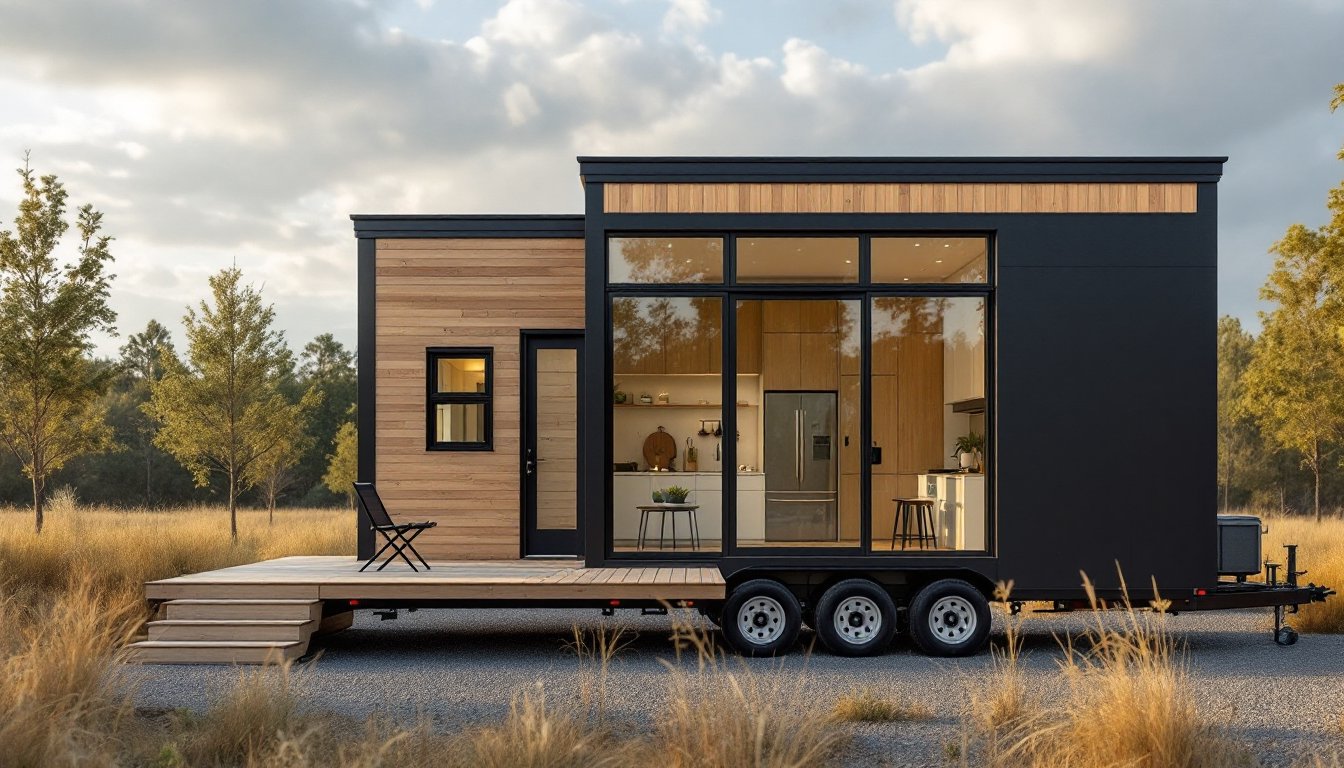
A modern tiny home typically ranges from 100 to 400 square feet and prioritizes clean lines, energy efficiency, and multi-functional design over rustic cabin aesthetics. Unlike traditional tiny houses that lean heavily on reclaimed wood and farmhouse charm, modern builds favor flat or shed roofs, large windows for natural light, and materials like fiber cement siding, metal panels, or thermally modified wood.
From a building standpoint, modern tiny homes often incorporate:
- SIPs (Structural Insulated Panels) or advanced framing techniques for better thermal performance
- Mini-split HVAC systems instead of space heaters or window units
- Low-E glass and strategically placed windows to reduce heat gain/loss
- Tankless water heaters or on-demand systems to save space and energy
Legally, definitions vary. The International Residential Code (IRC) Appendix Q covers tiny homes on foundations under 400 square feet, but many jurisdictions haven’t adopted it. RVIA-certified tiny homes on trailers fall under recreational vehicle standards, which affects where they can be parked long-term. Anyone considering a build needs to check local building departments early, some municipalities ban tiny homes outright, others allow them as ADUs (Accessory Dwelling Units), and a few have created specific tiny home villages with relaxed codes.
Benefits of Choosing a Modern Tiny Home Lifestyle
The appeal isn’t just about downsizing, it’s about intentional design and lower carrying costs. A well-built modern tiny home delivers tangible advantages:
Lower utility bills. With 300 square feet to heat and cool versus 2,000, monthly energy costs typically run $30–$80 depending on climate and insulation quality. Modern builds using spray foam or SIPs routinely hit R-values of 30+ in walls and R-50+ in roofs, cutting heating and cooling loads significantly.
Reduced maintenance. Fewer square feet means less roof to replace, fewer linear feet of siding to paint, and smaller HVAC systems to service. A standing-seam metal roof common in modern designs can last 40+ years with minimal upkeep.
Flexibility in location. Tiny homes on trailers (often built on triple-axle trailers rated for 10,000+ lbs) offer mobility that traditional homes can’t match. Foundation-built models work as backyard ADUs, providing rental income or housing for family members while staying within existing property lines.
Faster build times. A typical modern tiny home takes 3–6 months to complete versus 8–12 months for conventional construction. Prefab and modular options can cut that to weeks, though site prep and utility hookups still require planning.
Environmental impact. Smaller footprints mean less lumber, insulation, and finish materials. Many modern builders default to FSC-certified wood, recycled steel framing, and low-VOC finishes. Solar panel arrays sized for tiny home loads (typically 2–4 kW) become economically viable where they wouldn’t pencil out for larger homes.
Design Elements That Make Modern Tiny Homes Stand Out
Modern tiny homes succeed when every design choice pulls double duty. The aesthetic is clean and geometric, but the real work happens in spatial planning and material selection.
Open floor plans with defined zones. Without interior walls eating up square footage, modern designs use ceiling height changes, platform levels, or partial walls to separate sleeping, cooking, and living areas. A raised sleeping loft over a bathroom, for example, uses vertical space without sacrificing usable floor area below.
Large windows and glazing strategies. Oversized windows, often casement or awning types for better seals, bring in daylight and make small spaces feel larger. South-facing glass maximizes passive solar gain in winter: overhangs or exterior shades prevent overheating in summer. Many modern living spaces feature floor-to-ceiling glass on one wall to blur indoor-outdoor boundaries.
Neutral palettes with accent materials. White or light gray walls reflect light and expand perceived space. Accent walls using tongue-and-groove pine, 3/4″ plywood with exposed edges, or textured tile add visual interest without clutter. Matte black window frames and fixtures provide contrast without competing for attention.
Compact, high-efficiency fixtures. Modern tiny homes skip standard 30″ ranges for 24″ or 20″ models or use induction cooktops that require less clearance. Toilets are often composting or macerating models that don’t need traditional drain lines. Showers use corner neo-angle bases (typically 36″ x 36″) with frameless glass to avoid the cramped feel of curtain enclosures.
Smart Storage Solutions for Maximizing Space
Storage makes or breaks tiny home functionality. Modern designs integrate storage solutions directly into structural and finish elements:
Stair storage. If the loft is accessible by stairs rather than a ladder, each tread becomes a pull-out drawer. Stair risers typically provide 6–8 inches of depth, enough for shoes, books, or pantry items.
Built-in furniture. Benches with lift-up seats, Murphy beds that fold into walls, and dining tables that drop from the wall when needed all save floor space. These aren’t aftermarket additions, they’re framed and finished during construction. A fold-down table supported by a continuous hinge and folding bracket rated for 200+ lbs handles meal prep and workspace duties.
Overhead and under-floor storage. Cabinets that extend to the ceiling (using 12″ or 15″ uppers above standard 30″ or 36″ units) capture dead space. Trailer-based homes sometimes incorporate weatherproof storage boxes in the frame cavity between the floor joists and trailer deck.
Multi-function zones. A bench along one wall can serve as seating, storage, and a guest bed with a fold-out mattress. The area under a raised platform bed becomes closet space accessible from the side, eliminating the need for a separate wardrobe.
Magnetic and vertical organizers. Metal backsplashes hold magnetic knife strips and spice racks. Pegboard walls (painted or left natural) accommodate changing storage needs without permanent holes. Over-door racks and hooks turn every surface into potential storage.
Costs and Budgeting: What to Expect When Building or Buying
Tiny home costs vary wildly based on build quality, finishes, and whether it’s DIY, contractor-built, or factory-produced.
DIY builds: Expect $20,000–$50,000 for a basic but functional modern tiny home on a trailer. This assumes the builder handles framing, insulation, and finish work personally. Materials include a $5,000–$7,000 trailer, $3,000–$6,000 in lumber (using kiln-dried framing lumber and appearance-grade plywood), $2,000–$4,000 for windows and doors, and $3,000–$5,000 for electrical and plumbing rough-ins. Add $5,000–$10,000 for finishes (flooring, cabinets, countertops, fixtures).
Contractor-built custom homes: Plan on $60,000–$120,000 for a turnkey modern tiny home. Labor typically accounts for 40–50% of the budget. High-end finishes, quartz counters, European-style cabinets, porcelain tile, push costs toward the upper end. Contractors experienced in tiny homes understand weight distribution for trailer builds and code requirements for foundation models, avoiding costly mistakes.
Prefab and modular units: Factory-built modern tiny homes range from $50,000–$100,000 delivered. Quality control is better, build time is faster, and finishes are often standardized. Buyers sacrifice customization but gain warranty coverage and faster occupancy. Delivery and crane costs can add $3,000–$8,000 depending on distance and site access.
Land and site prep: Often overlooked, site work can equal the structure cost. Foundation-built tiny homes need a frost-protected shallow foundation or pier-and-beam system ($3,000–$8,000). Utility connections, electric service, water hookup, septic or sewer, run $5,000–$15,000 in rural areas, less in developed lots with existing infrastructure. Trailer-based homes still need a level gravel pad and utility hookups if parked long-term.
Financing challenges: Traditional mortgages don’t cover tiny homes on trailers. Some builders offer in-house financing: others require buyers to use personal loans or RV loans with higher interest rates (typically 6–10% versus 3–5% for conventional mortgages). Foundation-built tiny homes under 400 square feet sometimes qualify for construction loans if they meet local code.
Zoning Laws and Where You Can Place Your Tiny Home
Zoning is the biggest obstacle. A beautifully built modern tiny home is worthless if there’s nowhere legal to put it.
Foundation-built tiny homes as ADUs. Many cities and counties now allow Accessory Dwelling Units on single-family lots. California, Oregon, and Washington have statewide ADU laws that override some local restrictions, but size limits (often 800–1,200 square feet max), setback requirements (5–10 feet from property lines), and owner-occupancy rules still apply. A 300-square-foot modern tiny home easily fits these frameworks and can generate $800–$1,500/month in rental income depending on the market.
RV parks and tiny home communities. RVIA-certified tiny homes on wheels can park in RV parks, but many parks restrict long-term stays to 6 months or less. Dedicated tiny home communities are emerging nationwide, offering leased lots with shared amenities and relaxed dwelling standards. Lot rents typically run $300–$700/month.
Rural and agricultural zoning. Some rural counties allow dwelling construction with minimal restrictions, but septic permits, well drilling, and electric service can be expensive. Buyers should verify that a mobile/manufactured home isn’t required under local definitions, some jurisdictions classify trailer-based tiny homes as RVs, which can’t be used as primary residences.
Variances and exceptions. If local code doesn’t explicitly allow tiny homes, a zoning variance or conditional use permit might work. This requires a hearing, neighbor notification, and often $500–$2,000 in application fees. Success isn’t guaranteed, and the process can take months.
Building permits. Foundation-built tiny homes need permits like any other dwelling. Inspections cover foundation, framing, electrical, plumbing, and final occupancy. Trailer-based builds fall into a gray area, some jurisdictions don’t require permits if the structure is registered as an RV, others treat them as permanent dwellings the moment they’re hooked to utilities. Skipping permits to avoid hassle creates resale and insurance problems down the road. Those interested in contemporary furniture and fixtures should confirm that design-forward interiors still meet local code requirements for egress, ventilation, and safety.
Essential Tips for Transitioning to Tiny Home Living
Moving into 300 square feet requires more than purging belongings, it demands new habits and realistic expectations.
Downsize ruthlessly before moving in. Every item should justify its space. Duplicate tools, seasonal decor, and “just in case” storage boxes don’t fit. Digitize documents, photographs, and media. Sell or donate furniture that won’t fit the scale, standard sofas and dining sets overwhelm tiny interiors.
Prioritize quality over quantity. In a tiny home, there’s no room for cheap furniture that breaks or tools that don’t work. A well-made chef’s knife replaces a drawer full of dull blades. A compact washer-dryer combo (typically 24″ wide) eliminates laundromat trips, but only if it’s a reliable model.
Embrace outdoor living. Modern tiny homes work best when outdoor space extends the living area. A covered deck or patio (even 8′ x 10′) provides room for dining, entertaining, or hobbies that don’t fit indoors. Awnings, pergolas, or retractable shade sails make outdoor zones usable in more weather.
Plan for storage off-site if needed. Some tiny homeowners keep a small storage unit for seasonal gear, tools, or items they’re not ready to part with. A 5′ x 10′ climate-controlled unit runs $50–$100/month, still far cheaper than extra square footage.
Test the lifestyle before committing. Rent a tiny home for a week or month before building or buying. Living in 300 square feet sounds appealing until someone experiences how quickly clutter accumulates or how little privacy exists. Some people thrive in tight quarters: others discover they need more breathing room.
Understand maintenance realities. Tiny homes on trailers require tire rotation, bearing service, and frame inspections. Composting toilets need regular emptying. Propane systems (common in off-grid setups) demand leak checks and tank refills. Modern materials reduce upkeep, but no home is maintenance-free.
Anyone serious about tiny living should connect with local tiny home associations, visit builds in person, and talk to long-term residents. The difference between a tiny home that feels liberating and one that feels like a constraint often comes down to honest planning and design choices that match actual needs, not Instagram aesthetics.