
Table of Contents
ToggleMoving into a new apartment or rental home and need laundry equipment? Facing a busted dryer and can’t stomach a $1,200 replacement? Washer and dryer rentals offer a practical alternative to buying outright, especially for renters, those in temporary housing, or homeowners navigating tight cash flow. But rental fees add up fast, and the math doesn’t always favor convenience over ownership. This guide breaks down how washer dryer rental actually works, what it costs, and when it makes sense to rent versus finance or buy. No fluff, just the numbers, terms, and trade-offs you need to make the right call for your situation.
Key Takeaways
- Washer dryer rental costs $30–$90/month for standard options or $80–$150/month for rent-to-own plans, but rent-to-own can double your total cost compared to buying outright over 24 months.
- The financial break-even point for renting versus buying is 12–18 months; if you’ll stay put longer, purchasing with 0% APR financing from retailers like Home Depot or Lowe’s is typically cheaper.
- Rental agreements include delivery, installation, and maintenance coverage, but you’re responsible for damage from misuse, and rental units are often older and less energy-efficient than new models.
- Washer and dryer rental makes sense for temporary housing situations (6–12 months), those without upfront capital, or renters who value maintenance coverage over ownership equity.
- Used washer-dryer sets cost $300–$700 and offer a middle-ground option if you’re handy with DIY repairs, avoiding both high rental fees and large upfront purchase costs.
- Before committing to washer dryer rental, compare all options in a spreadsheet—standard rental, rent-to-own, retailer financing, and credit union loans—to determine the lowest true cost for your timeline.
What Is Washer Dryer Rental and How Does It Work?
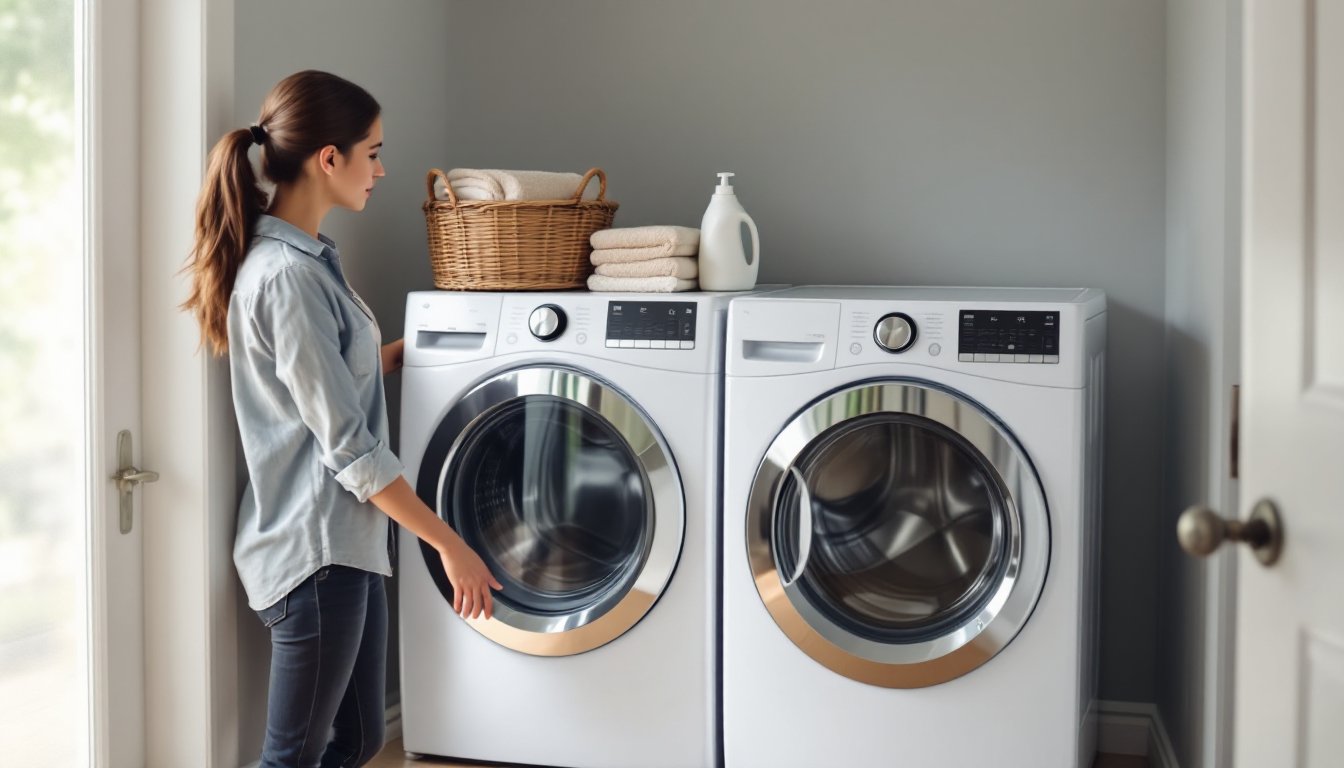
Washer and dryer rentals operate like appliance leasing: a rental company delivers a washer-dryer set to your home, you pay a recurring fee (weekly, monthly, or quarterly), and the company retains ownership. If the unit breaks, they handle repairs or replacement. When you’re done, whether you move, upgrade, or decide to buy, the company picks it up.
Most washer and dryer rental companies offer two main models:
- Standard rental: Pay a flat monthly or weekly fee. You never own the equipment, and rental periods can run indefinitely or on short-term contracts (3, 6, or 12 months).
- Rent-to-own (RTO): A portion of each payment goes toward ownership. After a set term (commonly 12–24 months), the washer and dryer become yours. Washer and dryer rent to own plans often cost more over time than buying outright, but they require no upfront credit approval or large down payment.
Rental agreements typically include:
- Delivery and installation: Hookup to existing water, drain, and electrical or gas lines. If you lack proper hookups (standard 120V or 240V outlet, 4-inch dryer vent, hot/cold water valves), installation may cost extra or be impossible without a plumber or electrician.
- Maintenance and repairs: The rental company is responsible for mechanical failures. You’re responsible for misuse or damage (overloading, clogged lint traps causing fires, or hookup leaks you cause).
- Swap or upgrade options: Some companies let you exchange units mid-contract for newer or different-capacity models.
Can you rent a washer and dryer for just a month or two? Yes, but short-term rentals command higher weekly rates. Expect to pay 20–30% more per week on a month-to-month contract versus a 12-month commitment.
The True Cost of Renting a Washer and Dryer
Rental fees vary by region, equipment quality, and contract length, but here’s the 2026 baseline for washer and dryer rentals:
- Standard rental: $30–$60/month for basic top-load washers and electric dryers. Front-loaders or stackable units run $50–$90/month.
- Rent-to-own: $80–$150/month, with total ownership cost reaching $1,500–$3,000 over 18–24 months.
- Delivery and setup: $50–$150 one-time fee (sometimes waived on 12-month contracts).
- Early termination: $100–$300 if you break a contract before the term ends.
For comparison, a mid-grade washer-dryer set costs $800–$1,400 new, or $300–$700 used. A washer and dryer payment plan through retailer financing typically spreads that over 12–24 months at 0–29.99% APR, depending on credit.
Let’s run the numbers on a 24-month scenario:
| Option | Upfront Cost | Monthly Cost | Total After 24 Months |
|---|---|---|---|
| Buy new (cash) | $1,200 | $0 | $1,200 |
| Finance (0% APR) | $0 | $50 | $1,200 |
| Standard rental | $0–$100 | $50 | $1,300 |
| Rent-to-own | $0–$100 | $100 | $2,500 |
Rent-to-own doubles the cost versus buying or washer and dryer financing. Standard rental breaks even only if you move or upgrade within 6–12 months.
One hidden cost: energy consumption. Rental units are often older, less efficient models. A rental top-loader can use 30–40 gallons per load versus 15–20 for an Energy Star front-loader, adding $50–$100/year to your water and electric bill.
Key Benefits of Renting Instead of Buying
Renting makes sense in specific situations where upfront cost, mobility, or credit access matters more than long-term savings.
No large upfront expense: Rental requires little to no money down, ideal for renters, recent grads, or anyone recovering from a financial setback. Many moving situations benefit from low-commitment appliance solutions.
Maintenance included: If the washer drum bearing fails or the dryer heating element burns out, the rental company replaces parts or swaps the unit at no charge. For homeowners who lack tools or DIY skills, this peace of mind has value.
Flexibility for renters and temporary housing: If you’re in a 6-month lease, military assignment, or trial relocation, washer and dryer for rent avoids the hassle of moving heavy appliances twice. Rental companies handle pickup when you leave.
Credit-building through rent-to-own: Some RTO companies report payments to credit bureaus, helping build or repair credit history. This matters if you’re working toward a mortgage or auto loan.
No resale hassle: When you upgrade or move, you don’t need to haul, list, or sell used appliances. Just schedule a pickup.
Drawbacks and Limitations to Consider
Rental looks appealing until you run the total cost or hit a contract snag. Here’s where the model falls short.
Higher total cost: As shown earlier, rent-to-own can cost double what you’d pay buying outright. Even standard washer dryer rental near me fees add up fast, $600/year turns into $3,000 over five years for equipment worth $1,200 new.
Limited selection: Rental inventory skews toward basic, builder-grade units. If you want a high-efficiency front-loader with steam cycles or a heat-pump dryer, you’ll likely need to buy.
Contract lock-in and penalties: Breaking a 12-month contract early can trigger $100–$300 fees. Miss a payment, and some companies repossess the unit immediately, leaving you without laundry access until you settle up.
Condition and age: Rental units are refurbished and redeployed. You may receive a washer with cosmetic wear, noisy bearings, or a dryer vent that’s partially clogged. Inspect on delivery and document any issues before signing.
No equity until fully paid (RTO): With rent-to-own, you don’t own anything until the final payment clears. Return the unit early, and you’ve gained zero equity, every dollar spent was pure rental.
Credit checks and approval: Even though the “no credit check” marketing, many washer and dryer financing no credit check plans still verify income, banking history, or prior rental accounts. Approval isn’t guaranteed.
Renting vs. Buying: Which Makes Financial Sense for You?
The right choice depends on how long you’ll need the equipment, your cash position, and credit access.
Rent if:
- You’re in temporary housing (6–12 months) and won’t take the appliances with you.
- You lack the $800–$1,400 for an outright purchase and can’t qualify for washer and dryer sets financing.
- You value maintenance coverage over ownership equity.
- You’re repairing credit and need payment-reporting from an RTO plan.
Buy (cash or finance) if:
- You’ll stay put for 18+ months. The break-even point for rental vs. ownership is 12–18 months.
- You have decent credit (600+ FICO). Retailer finance washer and dryer offers from Home Depot, Lowe’s, or Best Buy often carry 0% APR for 12–24 months on appliances over $499. This beats standard rental cost with zero interest.
- You want energy-efficient or feature-rich models (front-loaders, steam, smart connectivity). Rental stock rarely includes these.
- You can access washer and dryer payment plan options through retailers or credit unions at low or no interest.
Consider used + DIY repairs if:
- You’re handy and comfortable sourcing parts. A used washer-dryer set runs $300–$700 on Craigslist or Facebook Marketplace. Common repairs (belts, heating elements, inlet valves) cost $20–$80 in parts and 1–2 hours labor. Appliance parts are widely available at RepairClinic or AppliancePartsPros.
One overlooked option: appliance bundles with home purchase or lease. Some landlords include washer-dryer hookups or units: negotiate this before signing a lease. New-construction homes sometimes bundle appliances into the mortgage, spreading cost over 30 years at mortgage rates (currently 6.5–7.5% in 2026), cheaper than RTO.
Where to Find Washer Dryer Rental Options
National rent-to-own chains dominate the market. Aaron’s and Rent-A-Center operate in most metro areas, offering same-day or next-day delivery. These companies provide washer and dryer rentals near me with flexible terms and in-house financing (no bank required). Expect higher total costs and aggressive contract terms.
Local appliance rental companies: Search “washer dryer rental near me” to find regional players. Local outfits sometimes offer better rates and more personalized service than national chains. Ask about:
- Delivery and installation fees
- Minimum rental term and early-termination penalties
- Maintenance response time (24 hours? 48 hours?)
- Option to purchase outright mid-contract (and how much credit you get for payments made)
Big-box retailer financing: Home Depot, Lowe’s, and Best Buy offer washer and dryer financing through Synchrony, Wells Fargo, or Citibank. If you have good credit (660+ FICO), you’ll qualify for 0% APR for 12–24 months. This is effectively a free loan, just pay off the balance before the promo period ends to avoid retroactive interest (often 27.99% APR).
Appliance-specific financing: GE Appliances, Whirlpool, and Samsung offer branded credit cards or lease-purchase plans through Acima or Progressive Leasing. These are often washer and dryer financing no credit check arrangements but carry higher effective interest (lease factors of 1.5–2.0x retail price over 12 months).
Credit unions and personal loans: If you need to borrow but want to own outright, a credit union personal loan at 8–12% APR beats RTO’s effective 100%+ APR. Borrow $1,200, pay $110/month for 12 months at 10% APR, and you’re done, no contract, no returns, full ownership.
Online marketplaces: Credova, Katapult, and Acima partner with appliance retailers to offer lease-purchase at checkout. Read the fine print, these are often 90-day same-as-cash deals that convert to high-cost leases if not paid off quickly.
Before committing, compare total cost across options. Plug numbers into a spreadsheet: rental fees × term, plus delivery and any buyout cost, versus financed purchase with APR factored in. Consumer testing from trusted product review sources can help identify reliable washer-dryer models worth financing.
Conclusion
Washer and dryer rent works for short-term needs, tight budgets, or situations where maintenance coverage outweighs ownership. But beyond 12 months, the cost advantage evaporates. Run your own numbers, compare rental fees to retailer financing, and weigh how long you’ll actually need the equipment. If you’re staying put and can access 0% APR financing or scrape together $800 for a used set, buying beats renting every time. Rent when mobility or cash flow demands it, own when the math makes sense.